D81 form: the statement of information, question by question
What the D81 is
Form D81 is the statement of information for a consent order in relation to a financial remedy. When you apply for a consent order, GOV.UK lists it among what you send, with the signed draft order and Form A (GOV.UK, checked 28 September 2026). The current version is D81 04.25 (GOV.UK). It gives the judge a summary of your finances now and after the order, so they can decide whether to approve it.
One form or two
You can complete one joint D81 or a separate form each. Questions 23 and 24 are for separate forms: each of you confirms you've read the other's statement.
The questions
| Question | What it asks |
|---|---|
| 1 to 5 | Dates: the marriage or civil partnership (and when you started living together, if earlier), separation, the conditional order or decree nisi, whether the order is for interim maintenance, and whether the final order has been granted |
| 6 | Dates of birth: the applicant, the respondent and any children |
| 7 | How the agreement was reached, from the form's options |
| 8 | Capital now: property after mortgages, other capital, liabilities, pensions and PPF compensation, in columns for the applicant, the respondent and the children |
| 9 | Net monthly income now, lines A to M |
| 10 | Capital after the order, in the same layout as question 8 |
| 11 | Net monthly income after the order |
| 12 to 14 | Any other matters the court should consider, the main reasons for the division, and, if maintenance claims are dismissed, how each of you will support yourselves |
| 15 | Where each of you and the children will live, and on what basis |
| 16 | New relationships: the form's tick boxes, with dates |
| 17 to 17.2 | If property is transferred: notice to the mortgage provider and any objection within 14 days |
| 18 to 22.1 | If there's a pension order: notice to the pension arrangement or the PPF Board, any objection to an attachment order within 21 days, and whether the information required has been provided (the form cites Regulation 4 for the pension arrangement and Regulation 5 for the PPF Board) |
| 23 to 24 | For separate forms, confirmation that each of you has read the other's statement |
Each of you signs a statement of truth.
How the capital tables work
Questions 8 and 10 have the same rows, in the same order, for the applicant, the respondent and any children:
- Property 1, then property 2: value after deducting any mortgage(s)
- Other capital: bank accounts, savings, investments, ISAs
- Gross capital total
- Liabilities: loans, overdrafts and credit card debts, not mortgages
- Net capital total, excluding pensions and PPF
- Pensions valuation (cash equivalent) and PPF compensation valuation
- Total capital and pensions
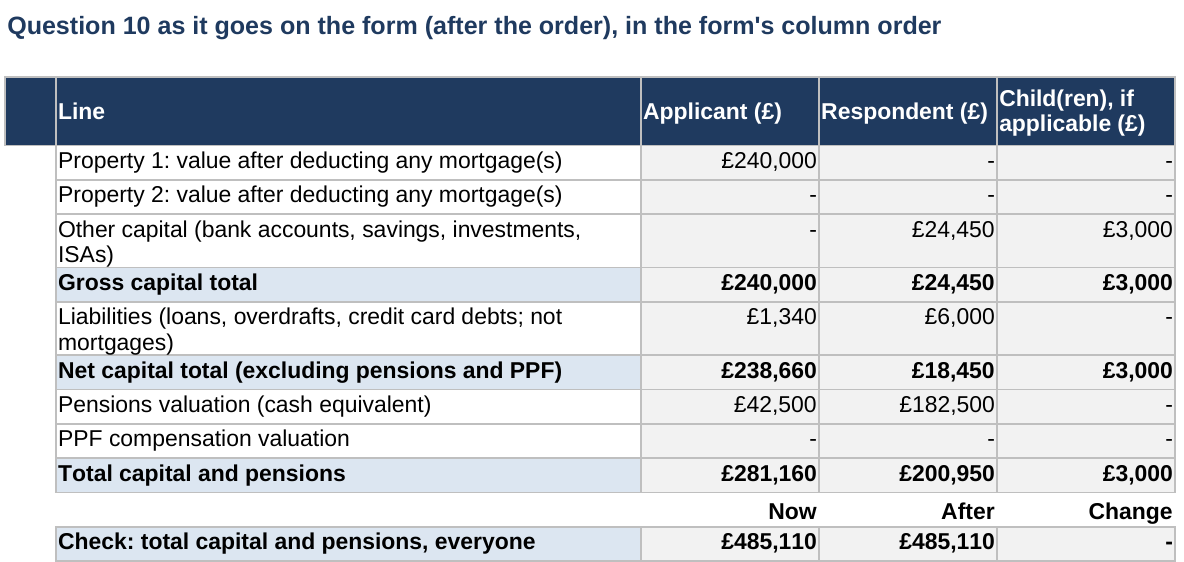
Joint items are divided in the shares in which they're currently held, and equally only if the shares aren't agreed (D81 04.25). Question 10 shows the same picture after the order: who keeps the home, who has which accounts, and how any pension share moves value from one of you to the other.
A useful check: unless money leaves or joins the picture (for example sale costs or new borrowing), the combined total for everyone should be the same in questions 8 and 10. Our D81 example shows it.
How the income questions work
Questions 9 and 11 ask for net monthly income. Amounts paid weekly, every 4 weeks or yearly are converted to monthly. Maintenance paid between you (lines G and H) is shown as a plus for the one who receives it and a minus for the one who pays, so the two should mirror each other.
Notice periods
- Transfer of property with a mortgage: the D81 asks whether the mortgage provider has objected within 14 days (question 17.2). The rules give a served mortgage provider 14 days, beginning with the date of service, to file a statement in answer (FPR 9.13(5)).
- Pension attachment orders: the D81 asks whether there's been an objection within 21 days (question 20). The rules count 21 days beginning with the date of service (FPR 9.34(3)).
What to send, and where
GOV.UK lists: the draft consent order, signed, with 2 photocopies of the signed original; the D81; and Form A. If there's a pension order, the D81 says to attach, if appropriate, any pension sharing or attachment annex, or pension compensation sharing annex. These are Forms P1, P2 and PPF1 (and PPF2 for a pension compensation attachment order) on GOV.UK's financial remedy forms page. The fee is £62, and you may be able to get help with court fees. For divorce cases, GOV.UK says to send them to HMCTS Financial Remedy, PO Box 12746, Harlow, CM20 9QZ. For civil partnership dissolution or legal separation, send them to the court dealing with your paperwork (GOV.UK, checked 28 September 2026).
The D81 Organiser builds questions 8 to 11 from one list of what you own and owe, in the form's column order, and checks the totals add up.
Common questions
Do I have to complete a D81?
GOV.UK lists the D81 among the documents to send with a consent order application (GOV.UK). You can fill in one joint form or one each.
What's the difference between Form E and the D81?
Form E is the full financial statement used in contested proceedings, with documents attached. The D81 is a shorter summary of your finances now and after the agreed order, sent with a consent order application.
Where do I get a blank D81?
From GOV.UK: Form D81. Check it's version 04.25 or later.
Sources
- Form D81 04.25 (GOV.UK)
- Apply for a consent order (GOV.UK)
- Family Procedure Rules, Part 9 (rules 9.13 and 9.34)
Free help: GOV.UK, Advicenow, or a solicitor or family mediator for advice about your own case.